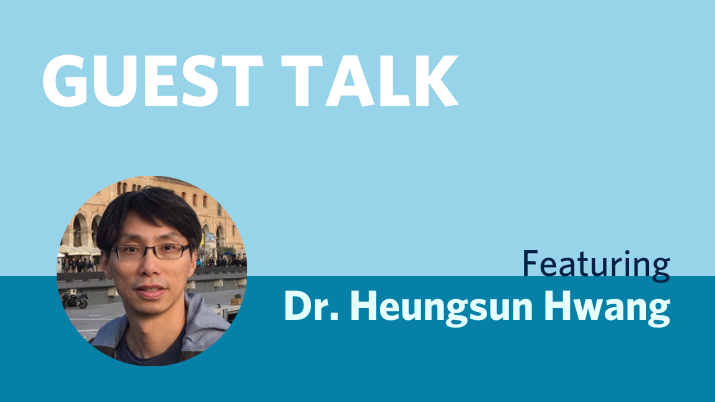
Dr. Heungsun Hwang joins us to share his insights and ideas o n A statistical approach for accommodating both latent and comp osite variables.
[gravityform id="106" tit le="false" description="true"]
Abstract
As soc ial sciences become more interdisciplinary\, there is an increasing need to simultaneously consider distinct types of constructs to understand human b ehaviour from diverse perspectives. Structural equation modelling (SEM) is widely used to examine theory-driven relationships between constructs\, suc h as self-esteem\, depression\, socioeconomic status\, etc. But\, tradition al methodologies for SEM make it difficult to model different kinds of cons tructs simultaneously: factors (also known as latent variables) need to be in a separate model from weighted composites of observed variables (also ca lled components). As researchers have access to larger datasets collected i n multiple modalities\, they need to be able to accommodate factors and com ponents into the same model. My colleagues and I recently proposed an SEM m ethod\, termed integrated generalized structured component analysis (IGSCA) \, to estimate such models. I will discuss the conceptual background of IGS CA and demonstrate its potential in real data applications with an investig ation of the effects of multiple genes on depression severity. I will also briefly discuss ongoing extensions of the method and illustrate how to use it with the free\, user-friendly software GSCA Pro.
Bio
Dr. Heu ngsun Hwang is a Professor of Quantitative Psychology at McGill Univers ity. He received a Ph.D. in Quantitative Psychology from McGill University. His research is devoted to the development and application of advanced qua ntitative analytics for the measurement and analysis of human characteristi cs\, aspects\, and processes. He is currently involved in the integration o f statistics\, psychology\, and machine learning to incorporate individuals ’ multifaceted (psychological\, physiological\, genetic\, etc.) information for a better understanding and prediction of their behavioural and cogniti ve differences. He has served on the editorial board of numerous journals\, including Psychometrika\, Psychological Science\, Behaviormetrika\, and th e British Journal of Mathematical and Statistical Psychology. Lab website: https://sites.google.com/ view/hwanglab/
CATEGORIES:Featured Homepage,Featured News and Events LOCATION:4038A\, B &\; C\, Audain Arts Centre GEO:49.263855;-123.254605 ORGANIZER;CN="cleobay":MAILTO:cleobay@mail.ubc.ca URL;VALUE=URI:https://psych.ubc.ca/events/event/guest-speaker-heungsun-hwan g/ ATTACH;FMTTYPE=image/png:https://psych.cms.arts.ubc.ca/wp-content/uploads/sites/2/2024/10/Heungsun-Hwang-Guest-Talk-1.png END:VEVENT BEGIN:VTIMEZONE TZID:America/Vancouver BEGIN:STANDARD TZOFFSETFROM:-0700 TZOFFSETTO:-0800 DTSTART:20241103T090000 TZNAME:PST END:STANDARD END:VTIMEZONE END:VCALENDAR