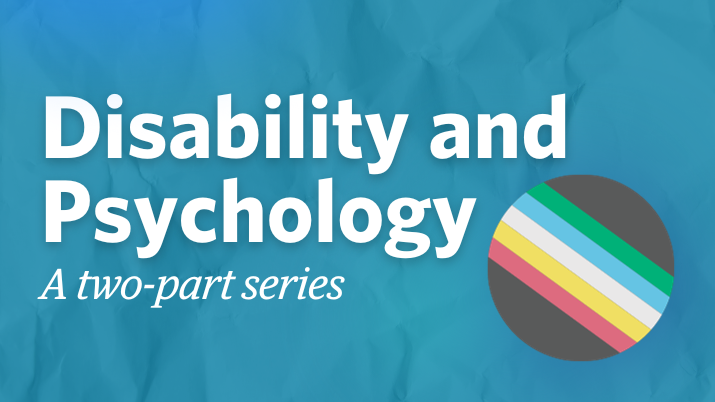
 The image includes the Disability Pride Flag. which was a collabora
tive design effort by Ann Magill\, a disabled woman\, with feedback within
the disabled community to refine its visual elements.[/caption]
The image includes the Disability Pride Flag. which was a collabora
tive design effort by Ann Magill\, a disabled woman\, with feedback within
the disabled community to refine its visual elements.[/caption][caption id="attachment_37172" align="alig
ncenter" width="715"] The image includes the Disability Pride Flag. which was a collabora
tive design effort by Ann Magill\, a disabled woman\, with feedback within
the disabled community to refine its visual elements.[/caption]
If you have wanted to learn more ab
out disability (what does that label really mean?)\,<
/i> ableism (how does bias towards disability manifest in academia
and my own life?)\, a
ccessibility (how can I create equitable environments in my lab/classe
s?)\, and/or the inte
rsection between disability and Psychology\, this EDI Dialogue and Learning series hopes to create opportunities
for these conversations.
For all of us in the Department of Psychology\, discussions on dis ability are highly relevant to our work:
Join us for a two-part series o n 'Disability and Psychology' this December. Come to one or both sessions\, depending on your interests.
Disability Justice: Unlearning Ableism by C ultivating Caring Communities
Friday\, December 8\, 2:00-3:30 PM< /p>
Hybrid: In-person\, Kenny 4001 and Online\, Zoom (RSVP for Z oom Link)
Note for in-person attendees: Dr. Gagnon will be bringing her service dog\, Ziggy\, for the ta lk\, and has requested that attendees wear masks (to be provided at the tal k). If these accommodations aren’t a good fit for you\, please consider att ending online instead!
Th is talk is intended to serve as a broad introduction to disability\, disabi lity justice\, and anti-ableism work.
[accordions collapsible= true active=false][accordion title="About Dr. Jennifer Gagnon"]Dr. Jennifer M. Gagnon (she/they ) (Ph.D.\, Political Science\, University of Minnesota\, B.A.\, Univers ity of British Columbia) is a Lecturer in the School of Journalism\, Writing\, and Media at the University of Briti sh Columbia (UBC). She has taught in a wide range of programs including Pol itical Science\, Classics\, Academic Writing\, International Education\, Eq uity and Inclusion\, and more. Her research is interdisciplinary and embrac es topics in Disability Studies\, political theory\, classics\, qualitative methods\, healthcare\, Universal Design for Learning (UDL)\, feminism\, an d gender. Her main area of research is in Disability Studies\, especially a s concerns gender\, inclusion and exclusion\, violence\, and visible and in visible disabilities. As an advocate\, she is involved in efforts and works hop facilitation on Disability Justice\, accessibility\, a culture of conse nt\, and LGBTQ2SIA+ inclusion both on and off campus. She is the creator an d President of UBC’s Disability Affinity Group which works towards the goal s of community care and Disability Justice. She is a recipient of the 2021 Killam Teaching Prize at UBC which recognizes excellence in teaching innova tion. Dr. Gagnon identifies as a bisexual settler and Disabled woman and st rives to bring her whole self to her teaching and research.[/accordion]
[accordion title="About Ziggy"]Dr. Ziggy Stardust (he/they)(Wag the Dog Service Dogs) is an in-training service dog who works side by side with Dr. Jennifer Gagnon as her supportive collaborator. Ziggy is a three-year-old Portuguese Water Dog and is very excited to start his journey working at UB C. Ziggy’s favorite things are doing Agility\, swimming\, off-leash trails\ , learning new tasks and tricks for treatos\, and hanging out with his Mom every single moment. You can follow Ziggy’s adventures on Instagram @DrZiggyDog[/accordion]
[accordion title="Full talk description"]Together we will explore how Disab ility Justice can be a catalyst for transformational change\, radically cri tiquing our ideas of “normal” and “productive\," while creating spaces of b elonging for Disabled folks who are often made to feel that their bodies an d minds do not “fit” in academia and our society. This talk will use the le ns of Disability Justice to explore the intersections of ableism\, disablis m\, medicalization\, and Disability as an equity-denied identity. Participa nts will be guided through reflecting on how these concepts intersect with mental health and psychology as a field of expertise\, as well as how these concepts are already present in their own work\, lives\, and contexts. Fin ally\, participants will be able to engage in critical reflection through l earning activities that focus on holding spaces that center access intimacy \, empathy\, and inclusion\, and will leave the workshop with resources for further unlearning of ableism using Disability Justice.[/accordion][/accor dions]
[buttons][button link_text="RSVP for part two of the series" l ink_url="https://ubc.zoom.us/meeting/register/u5wlce-uqz0iGtEc8mx_Uv1-eJmMy 4Te3Dj8"][/buttons]
For anyone
interested in furthering additional conversations around disability\, able
ism\, and accessibility in Psychology\, join the EDI Community of
Practice on Ableism & Disability Inclusion! Regular meetings (held via Zoom) are intended to start again in Janu
ary 2024. Contact Lily May (
Resources on disability at UBC/Psychology :
Disability Affinity Group: A collective of disabled folks from both UBC campuse s.
Disabilities United Collective: An advocacy and support resource group for disabled students at UBC.
[cards][card title="Looking for more reso urces?" text="Visit our EDI resources and support page for a consolidated r esource list." link_text="Visit now" link_url="https://psych.ubc.ca/edi/res ources/"][/cards]
CATEGORIES:EDI,Featured News and Events ORGANIZER;CN="khushimehta":MAILTO:khushimehta23710@gmail.com URL;VALUE=URI:https://psych.ubc.ca/events/event/edi-dialogue-learning-disab ility-part-1/ ATTACH;FMTTYPE=image/png:https://psych.cms.arts.ubc.ca/wp-content/uploads/sites/2/2023/11/Headers_20112023.png END:VEVENT BEGIN:VTIMEZONE TZID:America/Vancouver BEGIN:STANDARD TZOFFSETFROM:-0700 TZOFFSETTO:-0800 DTSTART:20231105T090000 TZNAME:PST END:STANDARD END:VTIMEZONE END:VCALENDAR