BEGIN:VCALENDAR
VERSION:2.0
PRODID:-//UBC Department of Psychology//NONSGML Events//EN
CALSCALE:GREGORIAN
X-ORIGINAL-URL:https://psych.ubc.ca/events/event/
X-WR-CALDESC:UBC Department of Psychology - Events
BEGIN:VEVENT
UID:20170210T1803Z-1486749781.5266-EO-10312-1904@10.93.0.117
STATUS:CONFIRMED
DTSTAMP:20250701T082056Z
CREATED:20160809T210139Z
LAST-MODIFIED:20200402T213639Z
DTSTART;TZID=America/Vancouver:20161110T170000
DTEND;TZID=America/Vancouver:20161110T181500
SUMMARY: Colloquium with Dr. Ellen Bialystok (Quinn Memorial Lecture)
DESCRIPTION: Each year\, the Quinn Memorial Lecture brings together the UBC
Psychology community and friends for an evening of dialogue and inspiratio
n. FEATURING Dr. Ellen Bialystok\, Distinguished Research Professor of Psyc
hology at York University. TITLE Lifelong Bilingualism: Reshaping Mind and
Brain ABSTRACT All our experiences contribute to the way our minds and brai
ns develop\, but intense […]
X-ALT-DESC;FMTTYPE=text/html: 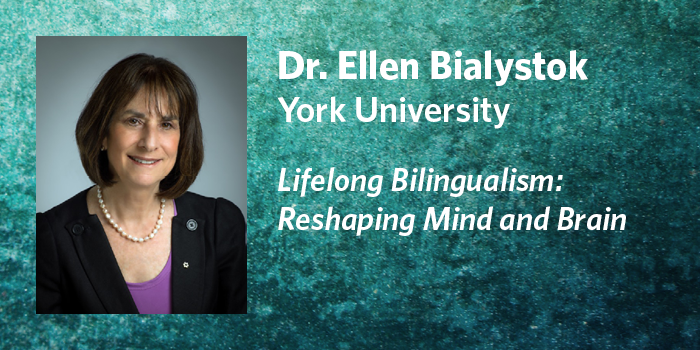 Each year\, the Quinn Memorial Lecture brings together the UB
C Psychology community and friends for an evening of dialogue and inspirati
on.
Each year\, the Quinn Memorial Lecture brings together the UB
C Psychology community and friends for an evening of dialogue and inspirati
on.
FEATURING
Dr. Ellen Bialystok\, Distinguished Research Profe
ssor of Psychology at York University.
TITLE
Lifelong B
ilingualism: Reshaping Mind and Brain
ABSTRACT
All our experi
ences contribute to the way our minds and brains develop\, but intense expe
riences have a special role in shaping our cognitive systems. As humans\, n
o experience is more intense or pervasive than our use of language\, so a l
ifetime of learning and using (at least) two languages has the potential to
leave a profound mark on human cognition. A large body of research conduct
ed with people at all stages in the lifespan\, from infancy to old age\, sh
ows that the experience of being actively bilingual reshapes the mind and b
rain. Beginning with infants exposed to two languages at home and ending wi
th older adults coping with dementia and neurodegenerative disease\, cognit
ive and brain outcomes are different for monolinguals and bilinguals. These
differences are generally in the direction of more precocious development
for bilingual children and more protection against cognitive decline for bi
lingual older adults. This talk will review the evidence from these studies
and propose an explanation for how exposure to and use of two languages le
ads to these cognitive and brain consequences.
BIO
Ellen Bial
ystok is a Distinguished Research Professor of Psychology and Walter Gordon
York Research Chair of Lifespan Cognitive Development at York University.
She is also an Associate Scientist at the Rotman Research Institute of the
Baycrest Centre for Geriatric Care. Her research uses both behavioral and n
euroimaging methods to examine the effect of experience on cognitive proces
ses across the lifespan\, with most attention on the effect of bilingualism
. Participants in these studies include children\, younger and older adults
\, and patients\, in an attempt to identify the mechanism by which experien
ce modifies cognitive systems. She has published extensively in the form of
books\, scientific articles\, and book chapters. She is a fellow of the Ro
yal Society of Canada\, Society for Experimental Psychology\, American Psyc
hological Society\, and other professional organizations. Among her awards
are the Canadian Society for Brain Behaviour and Cognitive Science Hebb Awa
rd (2011)\, Killam Prize for the Social Sciences (2010)\, York University P
resident’s Research Award of Merit (2009)\, Donald T. Stuss Award for Resea
rch Excellence at the Baycrest Geriatric Centre (2005)\, Dean’s Award for O
utstanding Research (2002)\, Killam Research Fellowship (2001)\, and the Wa
lter Gordon Research Fellowship (1999). In 2016\, she was named an Officer
of the Order of Canada for her contributions to our understanding bilingual
ism and for opening up new avenues of research in her field.
Th
e annual Quinn Memorial Lecture is made possible by a generous gift to our
department from prominent alumnus\, Dr. Michael J. Quinn (1927-2004). The e
vent showcases leading-edge research that has theoretical\, as well as prac
tical significance\, in the areas of consciousness\, cognition\, and memory
. It brings together UBC Psychology faculty\, students\, staff\, alumni and
friends for an evening of dialogue.
LOCATION:Jack Poole Hall-Robert H. Lee Alumni Centre
GEO:49.266057;-123.249755
ORGANIZER;CN="artspress":MAILTO:michael.ha@ubc.ca
URL;VALUE=URI:https://psych.ubc.ca/events/event/2016-quinn-memorial-lecture
/
END:VEVENT
BEGIN:VTIMEZONE
TZID:America/Vancouver
BEGIN:STANDARD
TZOFFSETFROM:-0700
TZOFFSETTO:-0800
DTSTART:20161106T090000
TZNAME:PST
END:STANDARD
END:VTIMEZONE
END:VCALENDAR